SPORTSWORLD.AM


Armenian national team striker Hrant-Leon Ranos has moved from Borussia Mönchengladbach to Spanish club Tenerife, the Armenian Football Federation press service reported.
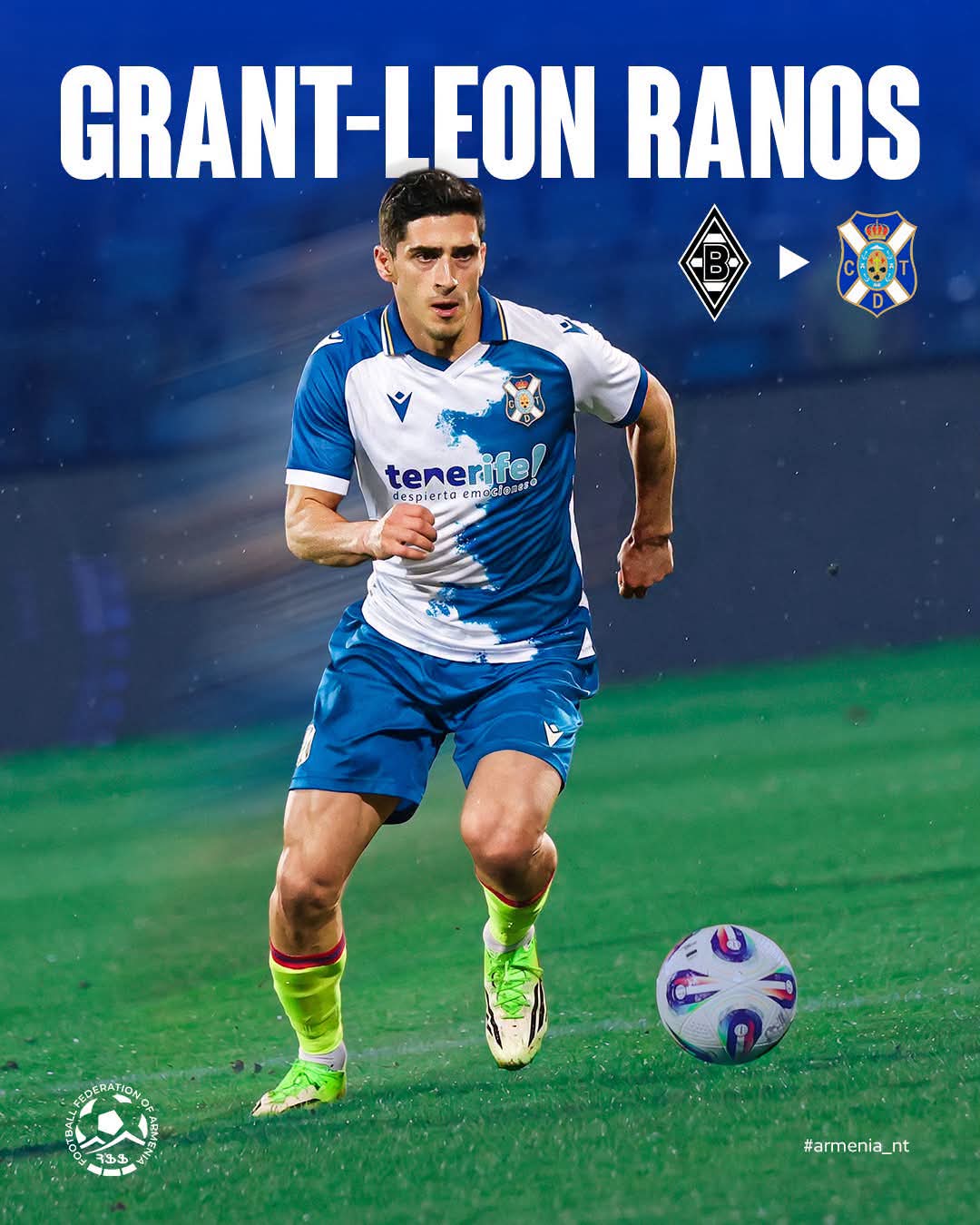
Tenerife was a Spanish football club from the city of Santa Cruz de Tenerife, playing in the Segunda División. Founded in 1912, they are multiple champions and winners of various regional cups of the Canary Islands and are one of the most popular teams in the archipelago. Some of the best periods in the club's history include the 1992–93 season, when Tenerife finished 5th in the Primera Division and reached the semi-finals of the Copa del Rey, which allowed them to make their debut in the UEFA Cup in the 1993–94 season, and the 1996–97 season, when Tenerife managed to reach the semi-finals of the UEFA Cup. They play their home games at the Estadio Heliodoro Rodríguez López, which seats approximately 22,824 football fans.
THE HISTORY OF AKUBI
Founded on 21 November 1912 as Sporting Tenerife, after the merger of several island football clubs, Sporting Tenerife won the Canary Islands Championship three times in a row, in 1914, 1915 and 1916, something no other team has done since. It is known that in 1915 Sporting Tenerife visited Andalusia, where they defeated Sevilla and Cádiz. In 1922, the club's management changed and the team was renamed Deportivo Tenerife. A notable detail is that until 2008, 1922 was considered the year of birth of the club. This fact has angered many historians, until in 2008 the Tenerife board created a special commission to resolve all disagreements. After an investigation, the commission recognized 1912 as the year of the team's birth. [ 1 ] In 1925, the team moved to the Heliodoro Rodríguez López Stadium, which remains the club's home stadium to this day.
Despite the foundation of La Liga in 1928, Deportivo Tenerife continued to play at regional level for decades. The club won the Canary Islands championship and various regional cups numerous times. The years of World War II and the post-war period were a serious challenge for Deportivo Tenerife. The club was on the verge of liquidation several times, narrowly avoiding worse. Deportivo Tenerife first had the opportunity to reach the Segunda División in 1950, but it was not until 1953 that it reached the top division.
Deportivo Tenerife debuted in the Primera Division in 1961, but returned to the Segunda Division after its first season. In 1968, after several unsuccessful years, the club was relegated to Segunda B. Despite continued failures, Deportivo Tenerife finally managed to return to Segunda Division in 1971, where they remained until 1978. In 1983, thanks to the efforts of club president Pepe López, the club returned to Segunda Division, from where they were relegated again after three uncertain seasons.
In 1986, new president Javier Pérez took over Deportivo Tenerife. At the time, the team was playing in Segunda B and had a debt of 320 million pesetas. Pérez brought in Martín Marrero, who managed to lead the team to Segunda B at the end of the 1986–87 season. A notable feature of this success was the club's 21-match unbeaten streak.
After 27 long years, Tenerife entered the Primera Division in the 1989/90 season. During the first few years, despite not showing the best results, the club often managed to avoid relegation, but the 1992/93 season changed everything. Under the leadership of Jorge Valdano, Tenerife achieved its highest result in its history, 5th place. In the same season, the club also reached the semi-finals of the Spanish Cup, setting another historical milestone. This success allowed Tenerife to celebrate its debut in the UEFA Cup in the 1993/94 season, where, after defeating the French "Auxerre" and the Greek "Olympiacos", they were eliminated in the 1/8 finals by the Italian "Juventus", despite a 2-1 home victory over the Italians. At the end of the 1995/96 season, player Juan Antonio Pizzi became the winner of the Pichichi Cup. In 1996, under the leadership of Jupp Heynckes, the club again finished 5th in the league. In the 1996/97 season, Tenerife began its regular season in the UEFA Cup, but lost in the semi-finals of the tournament to German side Schalke 04.
Return to Segunda (1999)
After 10 consecutive seasons in the Spanish top flight, Tenerife were relegated to the Segunda División. This was largely due to the club's poor financial management, particularly the signing of Domingos Pacienza, Tenerife's most expensive player in history, as well as the signings of players such as Vidmar and Anderson. On 17 June 2001, after two years in the Segunda División, Rafa Benítez barely managed to secure Tenerife's relegation from the Primera División through the play-offs. At the end of his tenure at the club, Benítez handed over to Pepe Meli, under whose management the club had a disastrous start to the Primera División. The crisis soon escalated, and in 2002 Mel was replaced as coach by Javier Clemente, who was also powerless to stop Tenerife's decline. At the end of the 2001–02 season, Tenerife were relegated to the Segunda Division, and the season itself was marked by hostility between the fans and the club's players. Club president Javier Pérez, who had held the position since 1986, also lost his position.
The club began 2005 with a debt of €54 million. Serious instability within the team almost led to Tenerife being relegated to the Segunda B division. Club president Víctor Pérez Ascanio resigned in 2006. That year was marked by a major scandal in which Tenerife was embroiled due to the activities of a number of island businessmen and politician Paulino Rivero, who were accused of speculation, corruption and attempts to conduct business under the club's name. The new club president was entrepreneur Miguel Concepción, and with his arrival Tenerife gained some economic stability. Concepcion managed to reduce the club's debt to 30 million euros, which initially did not raise much suspicion among the public, until the first news of speculation about the sale of the land appeared, which again caused criticism of the club's management, from journalists to political parties.
After spending several years in the Segunda Division, Tenerife returned to the Primera Division after the 2008/09 season, and the club's fans received the La Liga "Fan of the Season" award. However, internal club politics, as well as persistent debts, led Tenerife to another sharp decline, and the club was again relegated from the Segunda Division. During the 2010/11 season, the club's management allocated significant funds to sporting director Oltra to return to the Primera Division. His efforts in this direction were severely criticized by the fans. The start of the season, marked by a series of serious failures in the league and cup, led to the resignation of Tenerife coach Gonzalo Arconada. He was soon replaced by reserve team coach Alfredo Merino, until the appointment of Juan Carlos Mandia, who also failed to deliver the expected results. In an attempt to appease the fans, the club fired Oltra and appointed Juanjo Lorenzo as Tenerife's new sporting director. In an attempt to save the club from relegation, Juanjo Lorenzo soon replaced Mandia, stating that he had failed to justify the new sporting director's trust. Antonio Tapia was appointed as coach, but he also failed to save Tenerife from relegation to Segunda B.
In the 2011/12 season, despite internal instability and a change of coaches, Tenerife managed to finish 2nd in its group and reach the playoffs, where after a series of successes, it was eliminated by Ponferradina.
This season, the fans have shown incredible loyalty and support for their team during difficult times. The club is led by Álvaro Cervera in the 2012/13 season.
In the 2016/17 season, Tenerife reached the play-off final for the right to enter the Primera, but narrowly lost to Getafe to win a place in the top division.
sportsworld.am wishes our national team player success in the new stage of his career.